
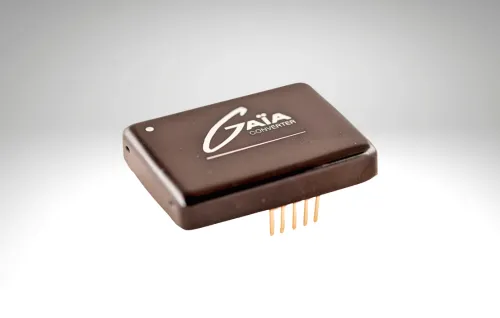
The power budget is often known at the end of development projects. In such cases, a pre-made DC/DC module can increase the chances of meeting the time-to-market for the entire product. The right DC/DC module manufacturer not only offers a module that solves the DC voltage conversion but also helps you meet requirements for filtering, transient protection, and other environmental standards.
Today, most DC/DC modules have an efficiency between 75 and 97.5%. Galvanically unisolated DC/DC converters have higher efficiency than isolated modules that lose power due to the isolation itself. Efficiency is usually stated for constant and full load at an ambient temperature of 25 °C. It is possible to save both money and board space if the DC/DC module is chosen based on how the load varies over time. A DC/DC module that has high efficiency at lower loads can be more effective in an application than the module that states the highest efficiency at the top of the datasheet.
A common requirement in various safety standards is galvanic isolation. Isolation can be used to reduce susceptibility to interference or to offer a different earth potential. In telecom, 48 V DC and positive earth are used on the input side, but a negative earth on the outputs. Medical applications have high requirements for isolation and leakage currents according to IEC60601. Isolated DC/DC modules have lower efficiency because the isolation material causes certain losses.
When calculating how much heat needs to be dissipated, it is important to consider the efficiency graph over different load levels at various input voltages. If the heat generation is managed effectively, not only is the efficiency increased, but the lifespan of the electronics is also extended. A common method for cooling DC/DC modules today, when there is limited airflow, is through a baseplate. This is achieved by mounting the baseplate either to the chassis or to a heat sink.
The railway industry lacks a standardised DC bus, equivalent to 28 V in the aviation industry or 48 V in telecommunications. Each country defines its own input bus voltage, ranging from 24 V DC to 110 V DC. The EN50155 standard defines all possible limit voltages, from the lowest (0.6 times nominal voltage) to the highest (1.4 times nominal voltage). To ensure equipment operates in different countries, an input voltage range between 14.4 V and 154 V is required.
The most common input voltages in the aviation industry are 28 V DC, 270 V DC or 115 V AC. To cover worldwide standards, input voltage ranges between 16 and 40 V DC or 70 to 180 V AC are often required. Transients and voltage drops down to 0 V must also be handled. Gaïa Converter offers filter modules, pre-regulator modules, hold-up modules, DC/DC modules and AC-DC modules to meet applicable standards such as MIL-STD-461 and DO-160.
For military vehicles, the requirements are governed by MIL-STD-1275, which was first issued as MIL-STD-1275A on 17th September 1976 and most recently as MIL-STD-1275E on 22nd March 2013. Older versions of the standard remain relevant when older military vehicles are updated with new electronics. The latest standard, MIL-STD-1275E, has been developed for modern military vehicles with multiple batteries. In MIL-STD-1275E, dealing with high-energy spikes (up to 2 J) is particularly challenging. Gaïa Converter offers solutions up to 300W, either as DC/DC modules that independently accomplish the task with a few external components, or as DC/DC modules combined with filters and pre-regulators to meet the most demanding requirements.
Gaïa Converters The new MGDD family offers a wide input voltage range and flexible output voltage thanks to new semiconductor circuits combined with new converter topologies. The latest MGDDI series has an input voltage of 12 to 160 V, making it easy to use with different battery standards. The challenge is to offer high efficiency across the entire input voltage range to keep the operating temperature within reasonable limits, given the expected lifespan. The new MGDD modules have two mutually isolated outputs that can be used in four different configurations: independent, parallel, series, or symmetrical. For example, two 24 V outputs can be connected in series to achieve a 48 V output voltage in a 60 W converter with a 12 to 160 V input voltage. Thanks to a trim function, output voltages such as 7.2 V or 9.6 V, or even 19 V for laptops, can also be achieved. The flexibility in terms of input and output voltage means that different conversion needs can be met with a single module.